A brain or spinal cord injury is not just a bigger version of a normal injury claim. Most of what you are owed is care you have not had yet, not the bills you have already been sent. Templer & Hirsch have recovered over $100 million for injured Floridians. Free case review, no fee unless we win.
If you or someone you love has been badly hurt, this is probably the hardest thing your family has faced. You are not alone in it. We handle the legal side so you can put your attention where it belongs, on recovery and on each other. When an injury changes what you can do for the rest of your life, the case changes too. The fight is not really about the emergency room bill. It is about what the next 30 or 40 years will cost, and the pay you will never earn. Templer & Hirsch have handled these cases for more than 35 years, and insurers do the same thing every time: they put a price on the claim using only the medical records they already have, before anyone knows what your future care will cost. Our job is to prove that future first, with your own doctors, a life care planner and an economist, so the offer covers a lifetime instead of a few months.
What Counts as a Catastrophic Injury in Florida?
Florida negligence law has no single definition, which is why insurers argue about the word. The closest the statutes come is Fla. Stat. 766.118(1)(a), the medical malpractice damages statute, and it is worth knowing because lawyers and adjusters both use it as a yardstick. It lists six categories: spinal cord injury involving severe paralysis of an arm, a leg or the trunk; amputation of an arm, hand, foot or leg involving the effective loss of use of that appendage; severe brain or closed-head injury shown by severe sensory, motor, communication or cerebral function disturbances or severe episodic neurological disorders; second-degree or third-degree burns over 25 percent or more of the body, or third-degree burns over 5 percent or more of the face and hands; blindness, meaning complete and total loss of vision; and loss of reproductive organs resulting in an inability to procreate. If your injury sits in one of those categories, the case is not a bigger version of a normal claim. Most of what you are owed is care you have not had yet.
The Life Care Plan Is What Sets the Number
In a catastrophic case the single most valuable document in the file is usually not a medical record. It is the life care plan: a costed, year-by-year projection of every surgery, therapy session, medication, wheelchair, prosthetic replacement, home modification and hour of attendant care you will need for the rest of your life. A qualified life care planner writes it, your treating doctors support it, and an economist reduces it to present-day dollars. Insurers attack life care plans in predictable ways, by arguing the care is not medically necessary, that replacement cycles are too short, or that a family member will provide attendant care for free. Those arguments are answered by building the plan early, with the treating physicians behind it, rather than assembling it the month before mediation.
Traumatic Brain Injury
Brain injuries run from a concussion that never fully clears to an injury that needs care for life. The hard part is proof. A mild brain injury often looks normal on a CT scan while the person cannot follow a conversation, keep a schedule, or go back to the job they had. We build these cases with neuropsychological testing, the treating neurologist, work records that show the drop-off, and family and coworkers who can say what the person was like before. A catastrophic injury attorney and a catastrophic injury lawyer are the same thing. What matters is whether the office has built a life care plan before, because that document drives the number.
Spinal Cord Injury and Paralysis
A spinal cord injury lawyer deals with the most predictable future costs in personal injury law, and the largest: daily attendant care, wheelchairs that have to be replaced on a schedule, pressure sore and bladder care, changes to the home and the vehicle, and the health problems that show up years later. Because those costs can be predicted, they can also be proven. A spinal cord injury attorney who does not build that record early is negotiating against a number the defense chose. Paraplegia and tetraplegia claims in particular live or die on the attendant care hours, because that line is the largest one in the plan.
Amputation and Limb Loss: What the Prosthetics Really Cost
An amputation injury lawyer is really pricing three things at once: the surgeries that follow the amputation, the prosthetic itself, and the decades of replacements after that. A prosthetic limb is not bought once. It is replaced on a cycle, and a high-function limb costs more each time, which is why a claim settled on today's device price falls short within a few years. Add revision surgery, phantom limb pain treatment, and the work you can no longer do. Fla. Stat. 766.118(1)(a) treats amputation of an arm, hand, foot or leg with effective loss of use as catastrophic, and juries understand these injuries without much explanation.
Severe Burn Injuries: What a Burn Injury Lawyer Has to Prove
Burn cases are among the most expensive injuries in personal injury law and among the least understood by adjusters. Serious burns mean a burn center transfer, debridement, staged skin grafts over months or years, contracture releases as scar tissue tightens, and pressure garments worn around the clock. Then come the parts nobody puts a number on easily: permanent scarring, heat and sun intolerance, and the psychological injury that follows a disfiguring burn. Florida treats second-degree or third-degree burns over 25 percent of the body, or third-degree burns over 5 percent of the face and hands, as catastrophic under Fla. Stat. 766.118(1)(a). A burn injury lawyer needs the burn surgeon, the reconstructive surgeon and a life care planner working from the same set of facts.
Blindness and Sensory Loss
Complete and total loss of vision is catastrophic by statute. Partial vision loss, hearing loss and loss of smell or taste after a head injury are not, but they can end a career just as surely, and they are routinely undervalued because they do not show in a photograph. These claims turn on vocational evidence: what work you could do before, what you can do now, and what the difference is worth over a working life.
Finding Every Policy That Applies
In serious cases the first insurance policy anyone finds is rarely enough. We look for extra and excess coverage, employer and business policies, uninsured and underinsured motorist coverage across every car in the household, a product claim if a defect played a part, and other at-fault parties such as contractors, property owners or vehicle owners. The difference between a fair recovery and a poor one is usually how many policies get found.
Damages in a Catastrophic Case
The claim covers care you have already had and care you will need, rehab and attendant care, lost pay and lost future earning power, changes to your home and vehicle, pain and suffering, and, for a husband or wife, the loss of the relationship. Future costs have to be worked out in today's dollars and backed by expert testimony. That is why we bring in your treating doctors, a life care planner and an economist early, instead of at mediation when it is too late to fix gaps in the record.
What To Do Now
Go to every appointment and follow the treatment plan, because missed care is the first thing the other side points to. Keep a short daily note of your symptoms and what you can no longer do. Do not give a recorded statement or take an early offer while the doctors still do not know the outcome. Call Templer & Hirsch for a free consultation. If getting to us is hard, we come to the hospital or your home. We take these cases from our Aventura office and across the state, including Fort Lauderdale, Hollywood, Coral Gables and Cape Coral.
Why $10,000 of PIP Never Covers a Catastrophic Injury
Florida's no-fault system was built for fender-bender injuries, not for a brain or spinal cord. Personal Injury Protection pays 80% of reasonable medical expenses up to $10,000, and only if a physician determines you had an emergency medical condition. Without that finding, the cap drops to $2,500 (Fla. Stat. § 627.736(1)(a)3-4). Either number is spent in the first days of a serious head or spine injury.
How much of your medical bills your own PIP pays
Florida no-fault benefits, per person, for one crash. A brain or spinal injury passes either amount in days.
With an emergency medical condition
$10,000 maximum
Without that finding
$2,500 maximum
PIP pays 80% of covered medical expenses up to these caps, and only for care that begins within 14 days of the crash (Fla. Stat. § 627.736). Everything past the cap has to come from a liable party, an employer, or your own uninsured motorist coverage.
14 daysTo start treatment or lose PIP entirely
2 yrsDeadline to sue in most negligence cases
51%Fault share that bars recovery completely
The threshold usually is not the problem here. In a Florida auto case you can only recover pain and suffering if the injury involves a permanent injury, a significant and permanent loss of an important bodily function, significant and permanent scarring, or death (Fla. Stat. § 627.737(2)). Catastrophic injuries clear that bar by definition. The real fight is over how much: future care, lost earning capacity, and the life care plan. That is where cases are won or lost, and it is why we bring in treating physicians, life care planners and economists early rather than at mediation.
Where We Handle Florida Catastrophic Injury Cases
We handle catastrophic injury claims from our Aventura office and across Florida, including:
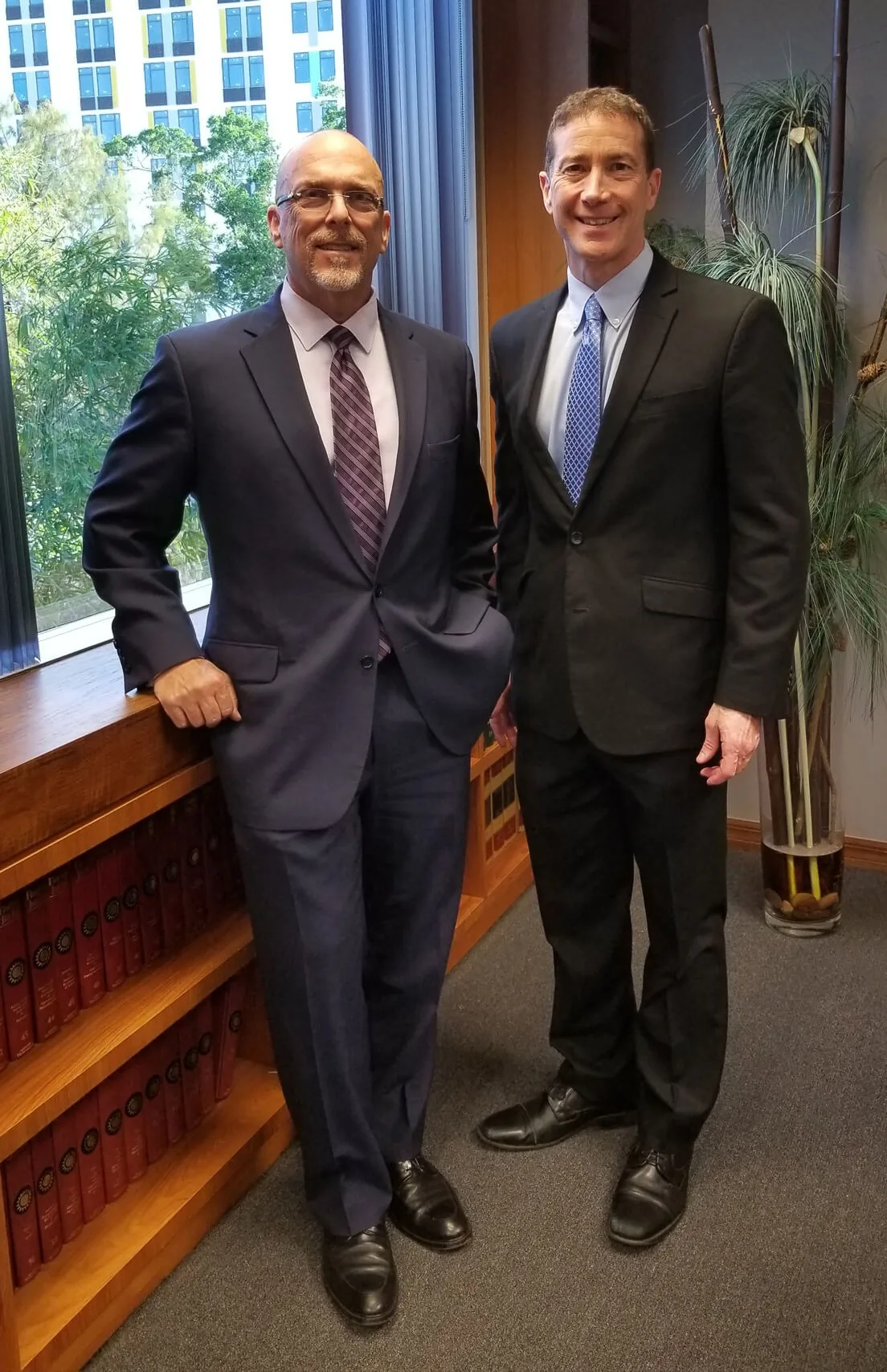
David L. Templer and Mark Hirsch at the firm's Aventura office
David L. Templer and Mark Hirsch have practiced from the same Aventura office for more than 35 years and have recovered over $100 million for injured people. You speak with an attorney, not a case manager, and the attorney you speak with is the attorney who handles your file.
There is no single definition in Florida negligence law. In practice a catastrophic injury is one that permanently changes what you can do: a traumatic brain injury, a spinal cord injury with paralysis, an amputation, severe burns, blindness, or an injury that ends your ability to work. The closest statutory list is Fla. Stat. 766.118(1)(a), which names severe paralysis from a spinal cord injury, amputation with effective loss of use, severe brain or closed-head injury, burns of 25 percent of the body or third-degree burns over 5 percent of the face and hands, total blindness, and loss of reproductive organs. The legal significance is that the damages are dominated by future costs rather than by the bills you have already received.
How is a brain injury case different from an ordinary injury case?
The evidence is different. A mild traumatic brain injury often does not show on a standard CT scan, so the proof comes from neuropsychological testing, treating physicians, and people who knew you before the injury and can describe the change. Insurers routinely argue that a normal scan means no injury, which is why documentation from the first days matters so much.
How much PIP covers my medical bills after a serious crash?
At most $10,000, and only 80% of covered expenses, and only if a physician determines you had an emergency medical condition. Without that determination it drops to $2,500 under Fla. Stat. § 627.736(1)(a)4. Care must begin within 14 days of the crash. Anything beyond the cap has to come from the at-fault party's liability coverage, your uninsured motorist coverage, or another responsible party.
Can I still recover if I was partly to blame?
Yes, unless you were more than 50% at fault. Florida uses modified comparative negligence under Fla. Stat. § 768.81, so your damages are reduced by your share of fault, and at more than 50% you recover nothing. In catastrophic cases insurers push hard on comparative fault precisely because the numbers are large.
What is a life care plan and why does my case need one?
It is a costed, year-by-year projection of the medical care, equipment, therapy, medication, home modifications and attendant care you will need for the rest of your life, prepared by a qualified life care planner and supported by your treating doctors. It is what converts a lifetime of need into a number a jury or an insurer can evaluate.
Is a catastrophic injury attorney different from a regular personal injury lawyer?
The title is the same, and no Florida certification separates them. The difference is in how the case is built. A catastrophic injury law firm brings in a life care planner, an economist and treating specialists in the first months rather than at mediation, and it goes looking for every layer of coverage instead of settling against the first policy it finds. Ask any firm you are considering how many life care plans it has put in front of a jury.
How are lifetime costs like prosthetics and attendant care actually proven?
Through the life care plan and the people behind it. Your treating physicians confirm what care is medically necessary, the life care planner prices it and sets replacement cycles, and an economist converts the total into present-day dollars the jury can award. Each of those three has to hold up on cross-examination, which is why the plan gets built with the doctors rather than around them.
How long do I have to file a catastrophic injury claim in Florida?
Most negligence claims must be filed within two years of the injury under Fla. Stat. § 95.11, cut from four years by the 2023 HB 837 reforms. Medical malpractice and wrongful death claims run on their own clocks. Evidence in catastrophic cases degrades fast, so waiting costs more than the deadline alone suggests.
Related Practice Areas & Calculators
Explore more ways Templer & Hirsch can help, and use our settlement calculators for federal maritime claims.