
A herniated disc settlement is not a number you can read off an MRI report. An MRI is the scan that photographs the discs in a person's back. Two people with the same cracked disc can walk away with very different money. What you get paid depends on facts no scan shows.
A disc is one of the rubbery cushions between two bones in a back. Herniated means one of them has cracked. Soft material inside pushes out onto a nerve, and that nerve is why your pain runs down a leg, and why you cannot sit at a desk all day.
Search for what one is worth and four pages hand you four different numbers. None of those pages knows anything about you. An insurance company does, and it values claims like yours every day. It has resources you do not, so the first offer is built for them.
Waiting costs you real money. In Florida you get two years to file a lawsuit over an injury. If you wait past those two years, you lose the claim outright. No insurance company is going to ring you about that, and the person who hurt you may carry no injury coverage either.
So let us walk through it in the order it happens to you, and by the end you will know which system pays for your disc, what your MRI proves, how your care moves the money, where the ceiling sits, and what to do next. I am Mark Hirsch, and I handle Florida injury and workers' comp claims, plus Longshore Act and Defense Base Act claims for workers across the country.
Key Takeaways
- Florida does not make drivers buy coverage for hurting you, so your own uninsured motorist policy is often the ceiling on a herniated disc settlement.
- Your MRI proves a disc is damaged, not what damaged it. 29 percent of pain-free twenty-year-olds already have a disc pushing out.
- Florida workers' comp pays a disc injury with medical care and wage checks, and nothing at all for the pain.
- A doctor's written limit on what you can lift moves a disc settlement more than the surgery does.
Step one: what a herniated disc settlement is built from
Here is the short answer: a herniated disc settlement is three piles of money added together, and the picture of your disc is not one of them.
- Your medical care, counted at what somebody actually paid for it.
- Your lost pay, the checks you have missed and the ones you will miss later.
- Money for the pain, and for the work and the sports you gave up.
Where that comes from: Florida law calls the first two economic damages and the pain noneconomic damages. Your care counts at the amount somebody paid to close a bill, never the amount printed on it. Our guide to Florida slip and fall settlement amounts walks through that rule.
So the back injury settlement amounts printed online, and every average settlement for a herniated disc with them, add up three piles from other people's lives. One of them had surgery and lost a warehouse job, and the next had six weeks of physical therapy and never missed a shift. An average of those two tells you nothing about your own back.
One question decides which rules apply to you, and most disc injury pages skip it.
Step two: which system pays for your disc
Three different systems pay for a herniated disc, and the one that covers you decides whether you get money for pain at all. The place you were hurt picks the system, not how bad the disc is.
Each lane pays for a different mix of bills, lost pay and pain. Here is who pays in each one, and what that payer covers:

A crash or a fall on somebody else's property puts you in the first lane. A herniated disc car accident settlement is paid by the driver who hit you, through their insurance. All three piles are open to you, and this is the only lane that pays for the pain.
Getting hurt on a Florida job puts you in workers' comp instead. Comp pays your medical care and part of your lost wages. It pays nothing at all for the pain, because Florida law makes benefits the whole deal an employer owes. You trade the right to sue your boss for money that arrives without a fight about fault.
A workers comp settlement for a herniated disc runs off an impairment rating, a doctor's percentage for the damage you are left with. Our guide to maximum medical improvement does that math.
Working on a boat, on a dock, or on a base overseas puts you in a third lane, under the Longshore Act or the Defense Base Act. A back is not one of the body parts on the federal list of set payments.
So a disc gets paid there as lost earning power. Federal law pays two thirds of the difference between what you used to earn and what you can earn hurt, for as long as you keep earning less. A warehouse worker who cannot lift again may collect for years, so a federal disc claim is often worth more than the same disc in state comp.
One lane can feed another. A delivery truck that hits you on the clock leaves you a comp claim and a claim against the driver, and our guide to suing after workers' compensation covers how those two settle up.
Your scan comes next in every lane, and it does not tell you what you think it does.
Step three: what your MRI proves, and what it does not
Your MRI proves that a disc in your back is damaged today. It does not prove what damaged it, and that is the whole fight over your money.
Radiologists pooled 33 imaging studies covering 3,110 people who had no back pain at all. Here is the share of those pain-free people whose scan showed a disc pushing out:

So 29 percent of pain-free twenty-year-olds already had a disc pushing out past where it belongs, and 43 percent of pain-free eighty-year-olds did. Plain wear in the discs ran higher still, at 37 percent by age 20 and 96 percent by age 80, in the same published review. None of them was in pain.
That study is why the insurance company has a one-word answer ready for your claim: degeneration. Its doctor reads your scan, calls the damage normal aging, and offers you the cost of a few therapy visits. No radiologist can date a crack in a disc, so the scan cannot argue back.
Your own report names the level where the damage sits. A lower back scan shows those discs plainly once somebody circles them.
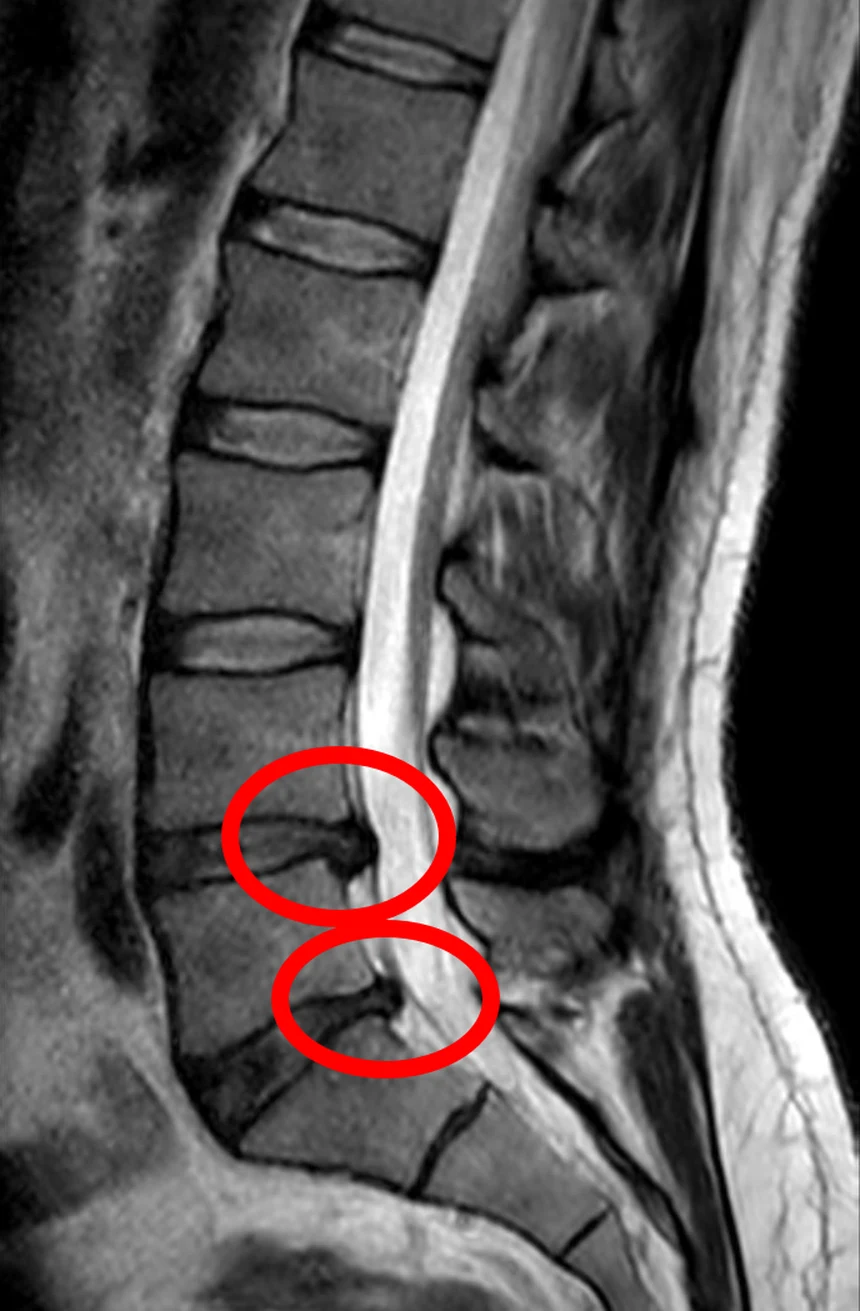
Three things out of your own records answer the aging argument. A doctor in the first week ties your pain to the day it started, because the visit is dated and the complaint is written down. Old charts showing you worked and lifted, set beside new ones showing you cannot, do the dating a scan cannot. Then your treating physician writes that the accident caused your symptoms, or woke up an old disc that never hurt before.
If you skip that first week and turn up six weeks later, you hand the insurance company its best argument for free.
An old disc does not end your claim. Florida judges read juries an instruction on exactly this problem. If the jury cannot separate the old condition from the new injury, the defendant pays for the whole condition.
The comp lane uses a stricter test. Florida workers' comp pays only when the work accident is more than half the reason for the injury, compared with everything else combined. Only a doctor can prove that, so a lifting injury on top of a worn disc lives or dies on what your doctor writes in the chart.
Once that argument is settled, your number starts to move. Your treatment moves it more than anything else does.
Step four: how your care decides the number
Your treatment decides the number more than the wording on your scan does. Each level of care you need proves the disc kept hurting, and proof like that is paid for.
Care for a disc runs in a known order, and the National Library of Medicine lays out the same order doctors follow.
- Rest and pain medicine, then physical therapy. Most people improve over weeks to months on this alone, and a claim that stops here stays small.
- A steroid shot near the nerve. A doctor puts a dose of steroid into the space around the pinched nerve to calm it down. Needing a second one tells an adjuster the therapy did not hold.
- A surgeon's recommendation. Surgery comes up when the pain outlasts the treatment, and the operation trims away the part of the disc pressing on the nerve.
- A written limit on your work. A doctor puts you on a 20-pound lifting restriction, or says you cannot go back to the job you had.
That last line is worth more than the first three, and almost nobody searching for an average knows it. Your medical bills are spent money, while a permanent limit on what you can lift takes pay out of every year you had left to work. So it carries the largest number in the file.
A clerk with a bad disc keeps typing and loses six weeks. A 34-year-old roofer with the same disc never carries a bundle of shingles again, and the second claim is worth many times the first.
Timing matters as much as treatment. The insurance company usually offers early, while your record still says sprain and therapy. The longer you go without a doctor writing down what you are left with, the better that early offer looks. That is exactly why it arrives then.
Treatment sets what your claim is worth. The money that actually reaches you is capped by something else.
Step five: the ceiling on what you can collect
Your claim can be worth plenty and still pay very little, because you only collect what somebody has coverage to pay. Most people guess wrong about where that ceiling sits in Florida.
Florida does not make drivers buy insurance for hurting you. The law asks for $10,000 of coverage for the car you damaged, plus no-fault medical coverage for yourself. Injury coverage for the person you hit is optional here.
So the driver who sent you for a scan may legally carry zero dollars for your disc, and your surgery, your lost pay and your pain all sit behind a policy that does not exist.
Then your own policy becomes the ceiling. Uninsured motorist coverage is the part of your own car insurance that pays when the other driver has nothing, or not enough. Your insurer has to offer it to you at the same limit as your injury coverage, and you can only turn it down by signing a form that says so.
The federal lane has a different kind of ceiling. A Longshore Act or Defense Base Act claim ends in a lump sum that a federal official has to approve, and the rules give that official 30 days to say yes or no. The test is whether the money is enough, so a cheap deal can be refused on your behalf.
Those same rules let you settle the money alone and leave your medical care open. An approved settlement closes the claim for good. If you sign away the medical side at 40 years old, every injection after that comes out of your own pocket.
So coverage caps your money and your proof builds it, and the next 60 days decide most of both.
Step six: what to do in the next 60 days
In the next 60 days you see a doctor, read your own scan report, ask the other insurer for its limits, and write one line a week about what you cannot do. Most of what a disc claim is ever worth gets decided in those two months, before anybody negotiates.
- Get seen, then keep every appointment. A visit in the first week dates your injury, and an unbroken run of visits after it answers the aging argument before an adjuster makes it.
- Read your own MRI report. Find the line naming the level, which looks like L5-S1 or C5-C6, and the word the radiologist chose. Herniation, protrusion and bulge are three different words, and the insurer will quote whichever is weakest for you.
- Ask the other insurer for the limits in writing. Florida gives that insurer 30 days from your written request to send you the coverage limits, the names on the policy and a copy of the policy itself.
- Say nothing casual on a recorded call. An adjuster rings while you are standing up straight and asks how you are doing. "I'm fine, thanks" gets read back to you two years later.
- Keep a one-line note every week. Write the shift you missed, the sleep you lost, the kid you could not lift. Nobody else writes that part of a disc claim down.
Once those five are done, the guessing is over. You know which policy pays you and what its limit is, and you know what your doctor will write about your back. You walk away with a number you can check instead of one you have to trust.
How we handle a herniated disc claim
We hunt down every policy that could pay you, which means your own uninsured motorist coverage and any policy on a relative living in your house. We get your treating doctor to write the two sentences a thin file is missing: what caused the damage, and what you will never do again. Then we price the years of lower pay rather than the bills alone, because an adjuster will leave that out.
Bring two things to the first call: your declarations page and your MRI report. Those 2 pages tell us within minutes whether your offer is low. We take Florida injury and workers' comp claims, plus Longshore Act and Defense Base Act claims for workers anywhere in the country.
Frequently Asked Questions
Do I need surgery for a herniated disc claim to be worth pursuing?
No. Plenty of disc claims settle with no operation at all, and the strong ones carry a steroid shot on the record plus a written work limit from a doctor. Surgery raises a number because it proves the pain did not go away, and so does a year of care that did not fix you.
How long does a herniated disc settlement take?
Longer than most people hope, because nobody can value the claim until a doctor can say what you are left with. That point may come six months in or two years in, and an adjuster who knows you are short of money will offer early for exactly that reason.
Does my health insurance get paid back out of my settlement?
Usually, yes. Medicare has a legal right to be repaid out of a settlement, and it charges interest if the money sits unpaid for 60 days. Most private plans carry a payback clause too, so ask for that figure before you agree to any number.
Is a herniated disc settlement calculator any use?
Not much. A calculator adds your bills and your lost pay, then multiplies the total by a number somebody picked, usually between one and five. That multiplier is a habit from negotiations, not a rule, and no calculator knows the coverage limit that caps your money.
I hurt my back working on a dock in Florida. Is that state comp or federal?
Dock work on the water is usually federal, under the Longshore Act, and those benefits beat Florida comp for a bad disc. Our guide to who is covered under the Longshore Act in Florida walks through the test. A worker hurt on an overseas base reads the Defense Base Act guide instead.